Since the announcement back in March of this year that Volkswagen had selected St. Thomas as the site of its first EV battery plant in North America, the majority of attention has centred on the new industrial park which will house the massive complex.
However, before the facility begins production in 2027, its impact will be felt in a major realignment of area roads and highways.
This includes the widening of Highbury Avenue and its extension to the Hwy. 3 bypass.
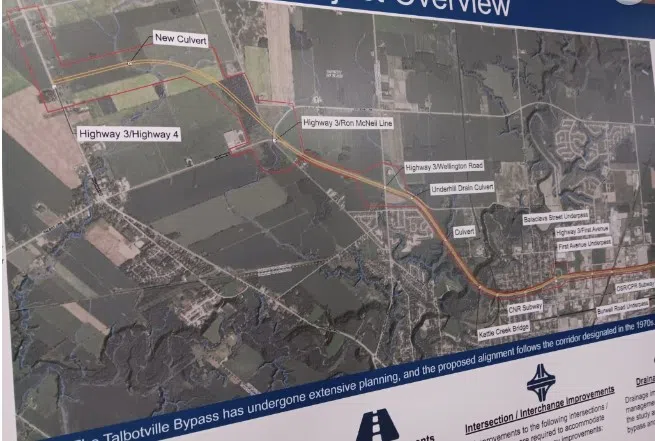
But a much more significant undertaking is the shape of things to come on the highway corridor between the city and Talbotville.
The new roadwork is designed to accommodate truck traffic into and out of the EV battery plant and involves three stages: the twinning of Hwy. 3 through St. Thomas to Ron McNeil Line; a new Hwy. 3 alignment that will bypass Talbotville; and the widening of Hwy. 4 from the new Talbotville bypass north to Clinton Line.
A well-attended public information centre was held on Aug. 17 in Talbotville where numerous concerns were voiced, in particular with the need to expropriate land.
The twinning of Highway 3 through St. Thomas will require a new interchange at Wellington Road; improvements to the First Avenue interchange; connection to the proposed Centennial Avenue roundabout (a city undertaking associated with the battery plant); and the twinning of the Kettle Creek Bridge.
The Ministry of Transportation is hosting a second public information centre fromo 5 until 8 p.m. on Wednesday, Nov. 22 at St. Anne’s Centre.
The purpose of the centre is to “provide the public and stakeholders with an opportunity to review the evaluation of alternatives and to present the preferred plan.”
The evening will be a drop-in format, with members of the project team available to discuss the undertaking and respond to questions.
Detailed documentation on this significant undertaking can be found at http://www.highway3elgin.ca