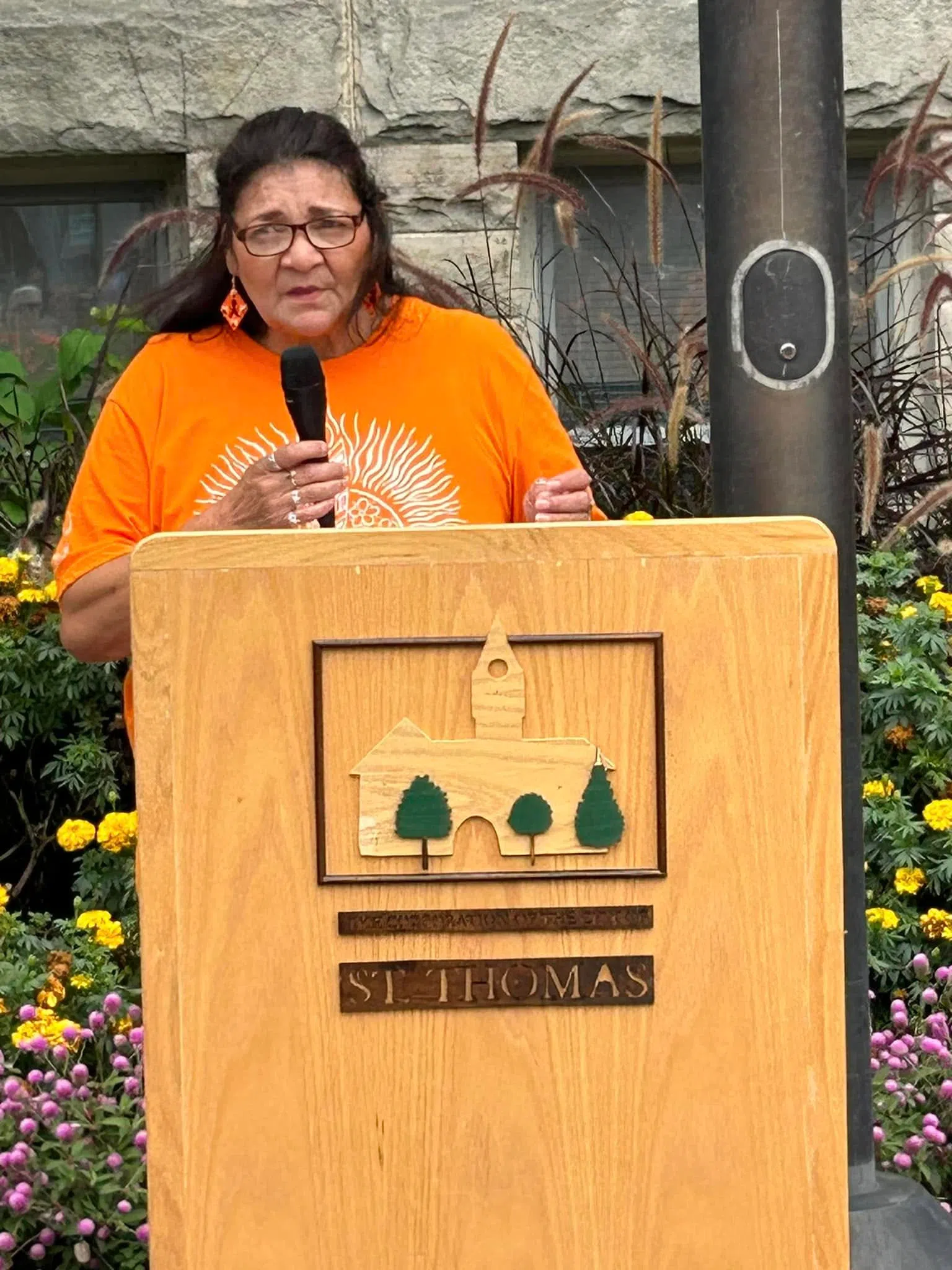
For the past five years, Betty Jean Phillips Budden and good friend Amanda Stark have organized Orange Shirt Day and National Day for Truth and Reconciliation ceremonies at city hall in St. Thomas.
Budden, who identifies with Oneida Nation of the Thames, will never forget the event in 2021 that launched her into action.
She remembers all the tears that flowed in late May when about 200 potential burial sites were discovered at the former Kamloops Indian Residential School.
Preliminary results indicated 215 children – some as young as three years of age – were buried at the site, according to Tk’emlúps te Secwépemc First Nation.
The Kamloops Indian Residential School operated from 1890 to 1969. The federal government took over administration from the Catholic Church to operate it as a residence for a day school, until closing in 1978.
That raw emotion was the incentive to hold a march on June 21 of that year, National Indigenous Peoples Day.
That led to organizing, along with Stark, the annual recognition in St. Thomas of National Day for Truth and Reconciliation, incorporating Orange Shirt Day, with the theme ‘Every Child Matters.’
Budden delved into the colour orange which was adopted as the campaign’s colour after Phyllis Webstad told the story of her new orange shirt being taken away from her when she was six years of age on her first day at a residential school.
Her driving force today is the plight of the urban Indigenous Person, of which she is one.
“That’s my plight, I never lived on the reserve.”
What Budden really would like to see moving forward is an Indigenous Peoples cultural centre in St. Thomas. Something similar to the N’Amerind Friendship Centre in London.
Budden drove that point home.
“We’re not just here on those two days, you know. We are here like every day of the year, right? And so, you know, that’s why I think it’s important to have a gathering place in St. Thomas. We are here and we need to have some place to be visible.”
Support is available for anyone affected by the traumatic legacy of residential schools and those who are triggered by the latest reports and recoveries. The Indian Residential School Survivors Society (IRSSS) can be contacted toll free at 1-800-721-0066. A national Indian Residential School Crisis Line has been set up to provide support for former students and those affected. People can access emotional and crisis referral services by calling the 24-hour national crisis line: 1-866-925-441.
Written by Ian McCallum